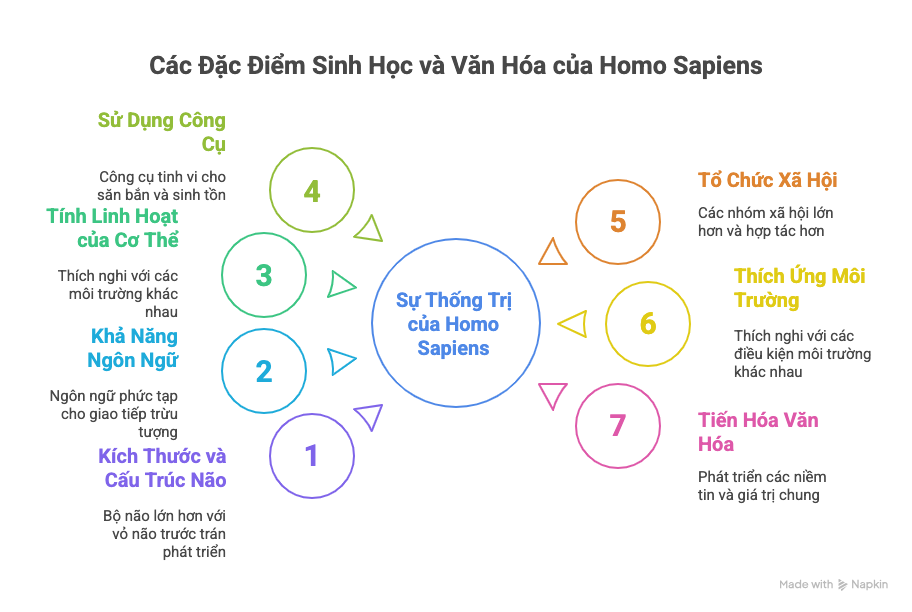
Large Brain and Complex Brain Structure:
Homo Sapiens possessed a larger brain than most other human species, with an average volume of about 1,350 cm³. However, brain size alone was not the key factor—Homo neanderthalensis (Neanderthals), for instance, had brains that were comparable in size, or even slightly larger.
The crucial difference lies in the structure of the Sapiens brain, particularly the development of the prefrontal cortex—the region responsible for abstract thinking, planning, and complex social communication. This allowed Sapiens to develop superior reasoning and creative abilities.
Advanced Language Ability:
One of Homo Sapiens’ most remarkable biological features was their capacity for complex and flexible language—far beyond that of other human species. Their language wasn’t limited to transmitting basic information (like warning of danger) but could also convey abstract ideas, tell stories, and create shared myths.
Harari emphasizes that this ability may have stemmed from structural changes in the throat and tongue, enabling Sapiens to produce a wider variety of sounds. While other species like Neanderthals had some communicative ability, it was likely less advanced.
Agile Bodies and Adaptive Physiology:
Physically, Homo Sapiens had smaller and leaner bodies than some of their relatives—Neanderthals, for example, were more muscular and had denser bones adapted for colder climates. However, Sapiens’ more slender build made them more agile, better suited to diverse environments from African deserts to temperate zones.
Their endurance in long-distance walking and running was another advantage, supporting activities like long-range hunting and migration.
Sophisticated Tool Use:
While other human species such as Homo erectus and Neanderthals also used tools, Homo Sapiens developed more advanced and specialized tools, such as sharp-tipped weapons, fishing nets, and multi-purpose instruments.
Thanks to enhanced hand dexterity and better hand-eye coordination (linked to brain structure), Sapiens could craft and wield tools with high precision, giving them a survival edge.
Social Structure and Cooperation:
Homo Sapiens tended to live in larger and more complex social groups than other human species. This cooperation was underpinned by their communication and social organizational skills, allowing them to coordinate more effectively in activities such as hunting, foraging, and defense.
Whereas Neanderthals typically lived in small groups (often fewer than 150 individuals), Sapiens were able to maintain relationships with much larger communities, thanks to their cognitive and linguistic abilities.
Environmental Adaptability:
Homo Sapiens showed exceptional adaptability to diverse environments—from tropical zones to icy landscapes. This was partly due to their ability to invent appropriate tools, clothing, and shelters, as well as their capacity to organize collectively to tackle environmental challenges.
This flexibility enabled Sapiens to migrate out of Africa and spread across the globe, while other human species remained confined to specific geographic regions.
Potential for Cultural Evolution:
Though not strictly a biological trait, Harari suggests that the biological features of Homo Sapiens—especially the brain and language skills—laid the groundwork for extraordinary cultural development. Their ability to create shared stories, beliefs, and value systems allowed Sapiens to eventually outcompete other human species.
For example, while Neanderthals may have had logical thinking skills, they lacked the ability to craft shared “myths” (like religion or ideology), which Sapiens used to unite large groups of people.
Impact of These Traits:
These biological characteristics—especially the brain and linguistic capacity—laid the foundation for the Cognitive Revolution (explored in more detail in Chapter 2). They enabled Homo Sapiens not only to survive, but to gradually dominate other human species and the ecosystem.
Harari emphasizes that although Sapiens did not initially appear superior, the combination of their biology and cultural potential created a vast difference—ultimately leading to the extinction of species like the Neanderthals and the rise of Sapiens as the dominant force on Earth.